Friday, February 5, 2010

epigraphy

Yesterday at the Sackler Library I made a discovery which truly reminded me why it is a classics library; I was in the bathroom and happened to glance at the walls, only to discover that the graffiti which covers the walls of every Mens Room was here written in Latin. Amused, both by the thought of contemporary Latin graffiti and by the content of said graffiti, I couldn't resist taking pictures, as well as doing a brief literary analysis...of the things written on shit-house walls:

For those who aren't familiar with the phrase, this is a rearrangement of Caesar's famous quote "I came, I saw, I conquered" - it now says "I saw, I conquered, I came," which I believe is cleverly playing on the sexual double-meaning of "to conquer" and "to come." It thus turns Caesar's laconic quip about war into an equally laconic description of a tryst. The other example of Post-Modern Classical Graffiti is far less ambiguous, however.

I apologize for the quality of this picture, but the writing was in pencil. It's far clearer in person. The script reads "Hic caccavit bene..." which roughly translates as "I had a good shit" (literally "this one shat well"). Interesting to note is the irregular spelling of the word "cacavit," a fascinating example of the non-standardization of spelling in the Post-Modern Classical academic world.

These two examples of lavatory artwork give us a stunning insight into the obscene nature of men from this era, for even the highly-educated elite find themselves scribbling obscenities into the walls of the water-closet. Such details of life in the early 21st century give nuance and flavor to even the most prestigious academics and help remind us why we study Post-Modern Classical Academia.

Tuesday, February 2, 2010

Earl Grey

While I was downing my second cup of it today, the question occurred to me, what is with this damn island and tea? When I lived in the states I might have tea once a week, if that. However from the moment I entered the United Kingdom, I've felt an undeniable attraction to this strange mixture of hot water and dried leaves.* Is it something in the water? Is it as my housemate Brett suggested and the British put a copious quantity of cocaine in their Earl Grey? Could there be an allele in the DNA of all people of English descent (including me - my mother's family's from York) that causes them to become tea junkies the moment they set foot on English soil? I don't know. All I do know is that since I got here I've been sipping my way through two cups a day. My favorite brand so far is Yorkshire Tea (appropriate, given my ancestry), which sells at Sainsbury's for 2.37 and comes with 80 teabags. At this rate, it's a good thing I'm buying in bulk.

*ok, so maybe "from the moment I entered the United Kingdom" is a slight exaggeration, but you get my point.

Monday, February 1, 2010

Castles and Cavaliers and Cannons, Oh My!

Two days ago the OPUS (Oxford Program for Undergraduate Studies, the study abroad program at Oxford) students took a field trip to Broughton Manor and to Warwick Castle and so I've created a bit of a slide show with some interesting commentary. I'm focusing mainly on Broughton Manor, since, as our Program Director Deepak said, it is more charming and less touristy, although Warwick is more historically significant. I will include some of the less commercialized photos from Warwick though.
The outer lawn of Broughton Manor. If I recall correctly, this was used in one of the scenes in Shakespeare in Love.

The Great Hall of the Manor. Apparently this is part of the original building and served as the living area and bedroom for most of the hangers-on of the Lord and Lady.

The wood paneling in the main dining room. It's hand done to resemble folded cloth and was really quite impressive. Before it was put up, the room, attached to the great hall, was originally the stores for the manor. It's located right below the bedroom of the Lord so that he could keep an eye on his stores in winter.

Queen Anne's Bedroom. Early in the reign of James I, him and his wife, Queen Anne of Denmark were touring Britain to acquaint themselves with the nobility and stayed at Broughton Manor for one night. This is the room that she stayed in. Apparently at that time, the nobility only slept inthe same bed as their spouses if they were seeking to be intimate. Makes the prospect of coitus a bit public for my tastes, but to each his own. It's ironic for me to criticize the practices, since it was probably a holdover from Roman times and I am a Latinist, but there you have it. As an aside, none of the furniture is original: in the 1800's, the Saye family had a member (pictured to the right) who was quite a spendthrift and who sold off all the Manor's furnishings. It was only at the beginning of the 20th century that the family was wealthy enough to refurnish it with different antiques. So unfortunately, while the room pictured is the one where Queen Anne slept, that is not the bed on which she slept, nor the sheets, etc.

This, meanwhile, is the bedroom in which King James I slept. Those of you who think that the columns and statuary are either far too old or too new to have been there in James' time are correct - if I recall from the tour, it was put in in the late 1700's or early 1800's and depicts dryads dancing around an oak tree.

What I found most amazing of all is the fact that the bed, which is extremely new in it's styling actually goes quite well with the sculpture and the green sylvan wall paper; very airy and pleasing to the eye. It's one of the few modern stylistic choices I've seen which I actually like.

This is the charter for Broughton Manor, signed and sealed by Henry VIII. Off screen to the right is another royal document which I neglected to photo, a pardon from King Charles II to the Saye family for having been involved in the parliamentary side of the English Civil War which saw the beheading of his predecessor, King Charles I. Speaking of the English Civil War:

A portrait of Oliver Cromwell. Cromwell never visited Broughton Manor, but the Manor was the location of many meetings by Parliamentary forces in the years leading up the the war, and later on the subject of a battle which the royalists won - hence the cannon balls pictured below, which were dragged out of the moat a few years ago. There's also the even-further-below picture of Cromwell: I took this photo not so much because of Cromwell, but because of the figure seated next to him - his Latin secretary, who would translate his

dispatches to foreign rulers into Latin. This saved the expense of having a translator for every language in Christendom - it was far easier for everyone to have a Latin translator who was also fluent in the local language. By the way, the identity of Cromwell's Latin translator? A certain John Milton. Yes, the John Milton.


After visiting the room in which the Parliamentary forces met, we stepped out through a door onto the roof. It's telling that they have no qualms about leaving the doors open - I'm not joking when I say that the temperature inside is actually colder than it is outside.


The British countryside, as viewed from the parapet of the Manor. The animals in the distance are sheep. One of the sights that really makes me appreciate rural England.

The gardens on the estate. I took this shortly before we left. As you can probably tell, they were simply gorgeous. If it weren't for the cold, I could see myself enjoying quite a lot of time there.

And just for laughs, here's me with a many-centuries old spear. When I saw people messing around with them, I just knew I had to do what I could to strike the pose of a Greek Hoplite. Okay, so my Hoplon is technically a backpack, but I improvised with what I had on hand, and you know that I was more than ready to drive those pesky Persians out of Hellas.

Guy's tower, as viewed from the exterior of the castle. This proved to be one of the more impressive features of the Castle, with a height which allowed it easily to view the entirety of the city of Warwick.

The next few images are all taken from the top of Guy's Tower:


Anyone interested in seeing the rest of the photos can check out the facebook album.

Tuesday, January 19, 2010

Academics with a twist

Well, yesterday I had my first Latin tutorial with Maarit (not counting the preliminary tutorial which I discussed in my last post). We met in the Old Lodge at Hertford College, in sight of the Bodleian Library. The tutorial system is more different from the American system than I first realized. On some levels it was similar to the Latin classes I've taken in the states in that the first order of business was to work through the text, going sentence by sentence, with an eye both to grammar and meaning. The major difference I see is that we got incredibly off topic - which to my mind is a good thing. That's not to say that we all of a sudden found ourselves discussing football scores; everything we discussed had to do with Classics. But the tutorial meandered from directly discussing Sallust, to pederasty, to Caesar and to Cicero. Perhaps the fact that she's my tutor for the Homer course as well lent the conversation greater breadth, but whatever the reason was, I liked it! It made the tutorial both more conversational and more informative. I think I've always learned best when I can talk one-on-one with my Professor (that would be the reason why some of you may have noticed that I can be almost obnoxiously vocal in class), and so for the reason, this style of learning is, I feel, particularly well-suited to me. There is an extent to which Maarit and I disagree - for example, she seems to feel that the relationship of Patroclus and Achilles is almost certainly pederastic, while I feel that while it most likely is, it could very easily be read otherwise - but in general, I think we're on the same page in terms of most topics. Which is good - it suggests that my interpretation of the material is most likely reasonable. I was also delighted to have her tell me at the end that I was very good at my translation, although she thought there was room for improvement. A good foundation to begin upon.

Afterwards I decided to do a little investigating; I'd heard from various people that the Sackler Library at Oxford was devoted to Classics and wanted to see for myself. Having first looked it up on a map, I found it nestled in a little side street by the Ashmolean Museum (I'm going to have to write a post on the Ashmolean later - it's well worth it). With its great iron doors and its Doric columns, this particular Classics library was easy to identify. I went in and immediately encountered my first problem: my Bodleian Library card wouldn't get me through the turnstile into the main lobby. I consulted the doorman and he kindly took my card and registered it in the computer system. Then I went back to the turnstile and with a swipe of my card it let me through. I then found myself in rotunda lined with all the ancient authors, from Cicero to Xenophon. Not only that, but the central area was packed with commentaries. As I was soon to discover, however, the Sackler, like so many other libraries in Oxford, is not a lending library - at least not to study abroad students. So any articles or books I make use of will have to remain within the confines of the building. Nevertheless, I'm really excited to have such a great resource at my disposal.

Wednesday, January 13, 2010

the trials begin

For people like Valerie, who want to hear about the academic side of things, this post is for you. It probably won't be plastered with photographs, or be necessarily as long as some of the other posts, but it should tell you about my experiences so far.

Yesterday, as per appointment, I met with Dr. Patrick Healy, my academic advisor for the term. I found out that I was scheduled to take my Latin tutorial with Maarit Kivilo, but my other class was a problem: I had signed up to take "War and Politics in Classical Civilizations" (a tutorial of my own design). However, the man who was most qualified to teach it was going to be commuting in between Oxford and London for the duration of the term. While it was possible that he could see me on Fridays, it wasn't looking very good, so Dr. Healy asked me, in the event that Fridays didn't work out, if I'd like to take a second course with Maarit. I responded that that was fine, and asked what I could study with Dr. Kivilo. Among other things, he listed Plato's Symposium, Greek Tragedy and Homer's Iliad. Now I've done some work on the Symposium before, and enjoyed it, but wanted to try something new, so it was down to either Greek Tragedy or Homer. Having long had a desire to read Homer, but never the impetus to do so, I chose that.

After my meeting with Dr. Healy ended, I went home and promptly emailed Maarit about the Latin, feeling it wise not to bring up the second course until we knew for sure that ancient war/politics was out. She responded that we should meet the next day, and made some oblique references to the Homer course, which I interpreted (correctly, as it turned out) to mean that ancient war/politics was off the table. We arranged to meet in the cafe at Waterstone books this morning.

Dr. Kivilo is not at all what you'd expect from an Oxford Classics Professor. She's an Estonian woman of about twenty-five or thirty, with close-cropped, spiked blond hair and green glasses; a far cry from the stereotypical tweed-wearing, pipe-smoking, elderly English gentleman who has become the archetype for academia in general and British academia in particular. Regardless, she is very friendly and seems so far to be extremely knowledgeable and passionate about the material.

The set-up: Oxford Study abroad students will be taking two classes. For most courses, the student writes a decent-sized paper each week, and then, at the appointed time, student and Professor meet so that the Professor can intellectually tear the paper apart while the student attempts to defend his or her statements. Language courses are rather different; the student is assigned a reading to do for the following week, and then student and Professor go through the text and try to extract as much meaning as possible from it. So, less stressful than a regular course, but still arduous.

Because Maarit knows that my particular interest is in the more politically-oriented texts, she suggested Sallust as the text for Latin. I was fine with this, and said as much, and after we discussed which editions were acceptable, we moved on to the Homer course. I was pleasantly surprised to hear that rather than just Homer's Iliad we were going to be discussing both the Iliad and the Odyssey. The shocker was that I was to have them both read "as soon as possible" (read: ideally within two weeks). My brain reacted in a way similar to the Oxonians' reaction to the recent snow: a mixture of elation and panic.

Sunday, January 10, 2010

Where everybody knows your name...

In my posts, you may have noticed an unusual number of references to various pubs. This, I think, is one of the more interesting differences between British and American culture. In America, a bar is seen as a somewhat nefarious place - a place for college students to get drunk, for alcoholics to waste their lives and for shady characters to conduct business which is better left undescribed.

Pubs in the UK are of an entirely different character; first of all, their clientele is not limited to the demographics common in American bars. I'm not sure I'd say that they're a communal gathering place, as my mother put it to me, but it's close to that. Everyone frequents pubs - Bus drivers, Shop Keepers, University Professors, everyone. The other point worth noting is that they're EVERYWHERE. I've been here less than a week and I can already name at least five Oxford pubs right off the top of my head - The King's Arms, the Turf, the Duke of Monmouth, the Crooked Pot, and the Eagle and Child.

The latter of these is quickly becoming a favorite of mine. It's a bit of a hike, but the food's good (that's the other difference: English pubs don't just provide drinks), the wine's Italian and it's just around the corner from the Ashmolean Museum, whose collection, for my money, is of lower quantity, but higher quality than the Metropolitan Museum of New York. It's also less than a hundred yards (sorry, meters) from Oxford's Classics Department, which I've not yet had the opportunity to explore. The atmosphere is also nice and quiet, with just the look one would expect from an English pub. Not to sound like a tourist, but there's also this little factor:


It's nice, while waiting for your meal, to contemplate the conversation that must have occurred within ear-shot of where you're sitting. The fact that two of the greatest authors in British history not only visited this place but frequented it lends it a certain mystique. It's magical to envision what it must have been like to hear Tolkien describe the Anglican roots of Middle-Earth or to hear the theological connotations behind Lewis' works (I confess, I've never read Lewis, so I'm speaking out of ignorance here), or to hear about some new language Tolkien was developing. Several years ago, I had the opportunity to meet a Cornell Professor named Robert Farrell, who studied at Oxford during Tolkien's time and knew him, so that we could discuss the man and his life. From this experience, and my time at the Eagle and Child (which Tolkien, Lewis, et al. nicknamed "the Bird and Baby") I can say that there's a certain indescribable quality that you perceive when you get close to Tolkien and his works. It's quintessentially English, a mixture of Gaelic myth, love of language, great literature, a less-hurried approach to life and an ancient, sleepy town which is paradoxically - or perhaps appropriately - the home of the greatest institution of learning in the world. It is the flavor of scholarship, and I love it.

Friday, January 8, 2010

Oxford: The Nazi Capital of England

For those of you scratching your head at the title of this entry, don't worry, I'll explain in time. After returning to the apartment with a full stomach and the liter of milk, I continued unpacking and quickly found that the adapters I'd bought for the British outlets were completely wrong, and thus, both my phone and the computer I'm typing on right now would have to survive on battery power for the moment - that, combined with the lack of internet on the first day, is the reason why my posts have been somewhat delayed. Venturing out of my room, my grocery trip soon came to seem ridiculously amateurish, as one of my flat mates entered the house with at least two bags stuffed with food. He and I started talking, and more people started trickling in. Looking around, I noticed that the kitchen in particular was extremely well-equipped. Back at Binghamton my dorm kitchen provided me with a stove/oven, a sink, a refrigerator and nothing else. Looking around in the flat, I was amazed to discover that we had been provided not only with utensils and mugs, but also pots, a strainer, wine glasses, shot glasses and even a George Foreman Grill.

As my flat mates came in, I got the impression (which was later confirmed) that a couple of them had been in Oxford for several days already. One of them suggested we go to the King's Arms and, although very tired at this point, I happily decided to tag along. I'm very glad I did. One of the things I've noticed since my stay in England is the fact that people go to bed earlier than they do in the states. It's rare for any business to be open after 7 PM, and even the pubs close at 11. So as we walked the mile or so into town, everything was completely quiet, partly due to the aforementioned sleep patterns of the Oxonians, but also partly due to the snow which had obstructed traffic and caused many of the residents to remain indoors.

Thus, the route to the pub seemed a medieval winter wonderland, with the cold crisp air heightening our awareness of the world around us. We traversed a bridge over a stream, some thirty feet wide, encroached upon by all manner of inns and various boats. I was informed that this is the beginning of the Thames River. We pressed on and passed by numerous Gothic limestone buildings, bedecked with columns and metal statues, and then the shops lining Broad Street which proudly displayed everything from books, to woolen garments to Oxford memorabilia. Finally we reached the King's Arms and found it a warm, cozy pub, brimming with people. Feeling it inappropriate to order anything else, I bought a pint of the local ale, hoping to continue my efforts to develop a taste for beer. After taking a few sips however, I quickly came to the conclusion that ale was not for me and instead ordered my preferred beverage, a glass of red wine. I gave the undrunk pint to Bridget, who was quite happy to have her second round be free. After some conversation about our experiences in Oxford, we all went home and retired, anticipating orientation the next day.

At eight hours long, Orientation is understandably the most agonizing event in a study abroad student's first few days at Oxford. Fortunately the staff does their best to lighten it by making the lectures humorous, and their success in balancing humor with important information is remarkable. The orientation was begun (and would largely be led) by Deepak Mukhi, the program's director. Deepak himself matriculated at Cambridge, and with his frequent praise of his alma mater, left us in no doubt of which institution he thinks is better. He lauded the Oxford Union, which is the local debate club, but took care to remind us that the one at Cambridge is still better. All this praise for Cambridge, he claimed, was to prepare us for the next speaker, Dr. Martin Holmes whom he said (correctly as it turned out) was a fierce partisan of Oxford.

As Deepak introduced Holmes, I was struck by how serious the latter looked, the very picture of British Academia. With such a serious persona rising to speak, I thought the jokes were over. This should serve to remind me that appearances can be deceiving. As it turned out, Dr. Holmes easily proved to be the most hilarious lecturer of the day, as he gave us an introduction to British society. True to Deepak's warning, he started by loudly informing us that "Oxford is the greatest institution for those who pursue truth and knowledge in the world!" Deepak promptly left the room. From there Holmes launched into a discussion of the royal family, taking care to emphasize that while the last crowned heads of Europe no longer fulfill a political role, they still perform a very important function as England's national soap opera. Laughter filled the room as he compared the various members of the Royal Family to television archetypes, and peaked when he informed us that while the women of England hate Prince Charles for cheating on Diana, the men are merely perplexed by him: for he divorced Princess Diana, one of the most beautiful women in the world for Camilla Parker Bowles, "who is as attractive as the back side of a London bus!" He then described the constant struggle between the middle class and the working class in England, complete with a tutorial on how to identify the classes, primarily by dress, but also by the intelligibility of their accents. Finally, and this is where the title of this post comes in, he reminded us not to forget that Oxford is the intellectual, not the political capital of England. There are two people, he says, who have forgotten that. The first was King Charles I, who during the English Civil War made Oxford his Capital. His life ended when his head was separated from his torso at the end of the War. The other was Adolf Hitler, who early in World War II ordered Goering to bomb London into the ground but not to touch Oxford. For when they had conquered England, London would be bulldozed and Oxford would be made the new capital. As we all know, Hitler ended his life in 1945 after a trashy wedding to his mistress Eva Braun and more than his fair share of megalomaniacal delusions.

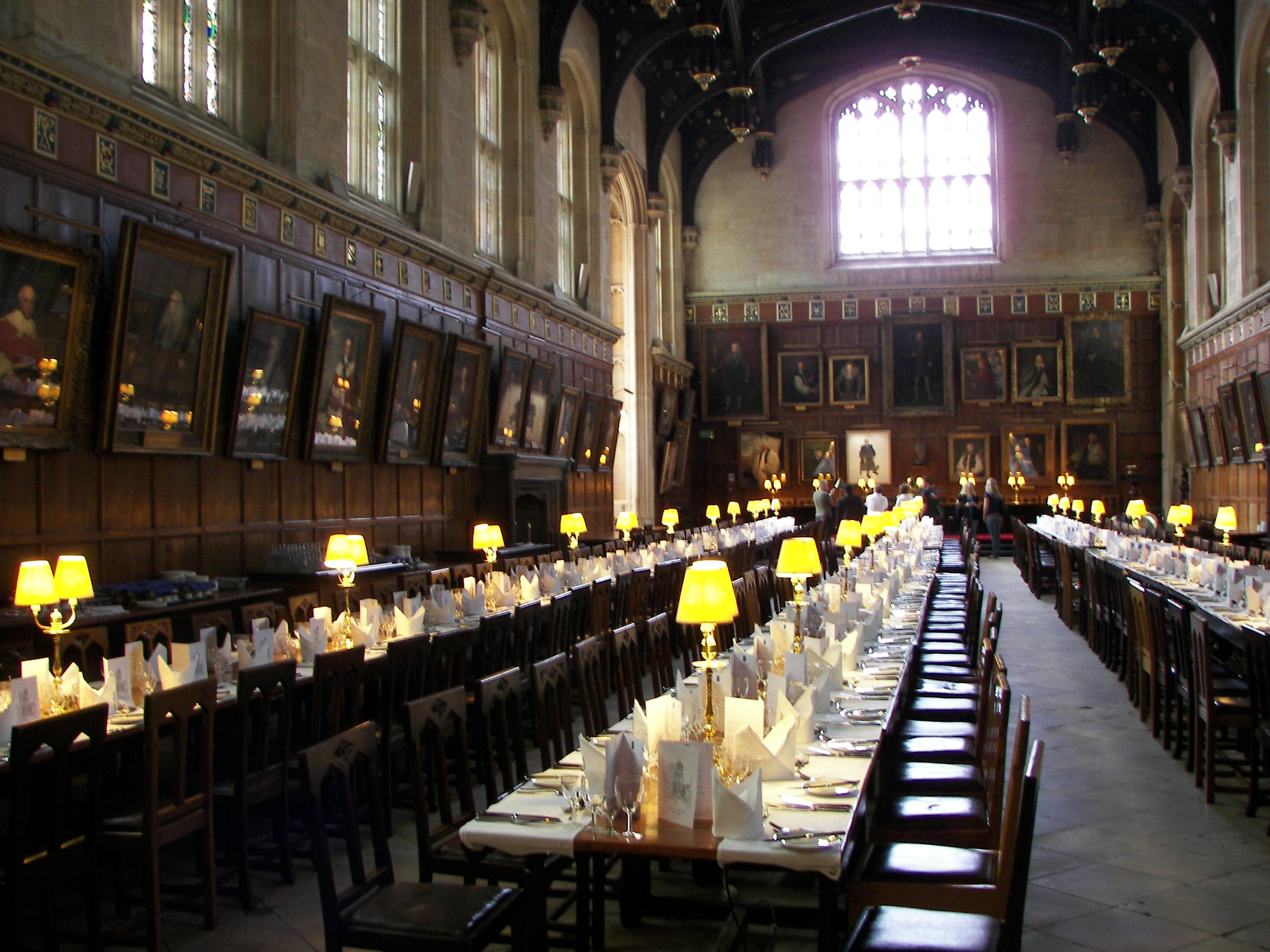
Following Holmes's talk, Deepak returned to continue his lectures on the ins and outs of living in Oxford, ranging from transportation to phone service to the internet. During this period we broke for lunch and ate at Hertford Dining Hall, which bears a passing resemblance to the Great Hall at Hogwarts (the actual Hogwarts Great Hall is located less than a mile away at Christ Church College). Also worth noting was the discussion on the Bodleian Library, which is one of only three Copyrighted Libraries (Libraries which receive, free of charge, copies of every book and journal article written) in England. In order to make space for such a colossal collection, the majority of the earth underneath Oxford is owned by the Bodleian, which has honeycombed Oxford with underground chambers filled with books. Even so, they're quickly running out of space. Our status as students at Oxford permits us to use this incredible resource, although like anyone else, we are not allowed to borrow books from the Bodleian.

Around five, the orientation ended and I rushed out to try to get to Curry's, the local electronics store, in order to get an adaptor for my computer's power cord. Unfortunately, when I got there they were already closed, so I headed home, only to realize that I didn't have my keys with me. I ended up stopping at the Duke of Monmouth, the closest pub to my house for a glass of wine in order to kill time before my flat mates returned home.

Thursday, January 7, 2010

The Old World

Sorry I took so long in getting this up, but it's taken a long time to work out some of the logistical kinks in getting online (first wireless problems, then non-functional adaptors for the computer power cord). I got to the airport about two hours early, so I had plenty of time to check my luggage and get on my flight.


After that it was a a 6 hour flight and we were instructed to close the blinds, so that the sun wouldn't wake people, and I largely slept and watched Inglorious Basterds.


Around an hour before the plane landed I awoke and out of curiosity opened the blinds. I was greeted with this amazing sight:


A blanket of clouds spread out beneath us, gorgeous in the morning light. After a smooth landing at Heathrow we proceeded off the plane and after getting my luggage (I have to say, I can think of few things more boring than waiting for the conveyor belt to bring your luggage) and exchanging a few of my twenty's for British pounds I made a few discoveries about the local culture:

Pro: The ten pound note has Charles Darwin on the front! I can not IMAGINE the U.S. Mint getting away with something like this. Also worth noting, the two pound coin has the DNA double-helix on the back. I love this celebration of scientific achievement. Don't get me wrong, I like America's tradition of putting important political figures on their currency, but this was a shocking and welcome change.

Con: Do not try getting water in England. Ever. I tried getting a glass of water at a coffee kiosk and the woman gave me a weird look and told me they just had mineral water. Water fountains? Don't exist. And I was half-expecting to find that the faucets spouted mineral water too (thankfully, the one in my room features regular old H2O)

Having made these discoveries, I walked outside to find that Britannia was (and still is) apparently in the middle of its worst snow storm in 30 years (for us up-state NY-er's, this translates to the worst snow storm in about 3 weeks). I was tempted to scoff, but then decided it might not be a wise idea to out-stiff-upper-lip the British. I got on my bus to Oxford instead. After falling asleep on the bus for about an hour, I awoke to Gothic architecture and a vibrant medieval-era village.


Crisis #1:
Unforunately, I was soon to discover that the snow would prove more of a problem than I had anticipated. It didn't bother me, but since the Oxonians (apparently that, rather than something like Oxfordian, is the term for a resident of Oxford) were completely unused to this weather, they were hovering somewhere between elation and panic. Thus, when I got off the bus and tried to hail a cabby, I was informed that they'd been told they were not allowed to drive on anything but the main roads, and thus could not drive me to the porter's lodge where I'd be getting my housing assignment. "Ok," I said, "then can you just take me as far as you can?" The cabby said I should just walk as it wasn't far. What I don't think he realized is that when you're carrying four bags stuffed with clothing, hats, medical supplies and a computer, anything more than ten feet is FAR. I ended up dragging those bags about a half mile before I made it to the porter's lodge. Not fun. I'm still sore from it. I think at that point I was beginning to think maybe I shouldn't have come.

Fortunately, once I'd grabbed my house key, I was able to call a cabby who WASN'T afraid of a couple inches of snow and he very graciously helped me load my bags into his Mercedes (no joke) and drove me to my flat. When I got inside, I grabbed the first unoccupied room I could find (which was mercifully on the first floor) and started unpacking. Fresh from discovering that the British can't even fathom drinking regular water, I was elated to discover it has a faucet.

Crisis #2:
It was at this point that I realized the one thing I had forgotten: food. Now, this may not seem like much of a problem, but when you're a diabetic in a house with no food and your blood sugar tanks (as mine did) this seems like a rather large problem. Add to that the fact that I was jetlagged and I was not in good shape. Thankfully one of my flat mates had half an unfinished falafel which she kindly gave me, and after wolfing that down, I decided to catch a bus downtown and find a) a meal and b) some low-blood sugar snacks to prevent it from happening again.

Looking back, the venue for my first real meal in England seems ironic: McDonald's. Having tried a British Big Tasty, I can safely say that, for better or worse, the English have not mastered fast food (add that to the list of plumbing, electical work, the internet and dentistry). The sauce on the burger tasted strange and the fries were sour and salty rather than just salty. But, it was food. After that I stopped in at a local convenience store and bought a litre of milk, some ritz bits for future low blood sugars, and a cookie for my kind flat mate.

Tuesday, January 5, 2010

Tomorrow...I mean today... is the day

Well, this is it - my last day stateside for six months. Times like this I start getting wistful. I'm not going to see this land for a long time. Or at least, longer than it's ever been (I think my record for spending time outside the USA is when I went to Canada once - it was less than 24 hours). I wonder who I'll be when I get back. Or what the world will be. Is there really any difference? The world we see is a reflection of ourselves, for how we process what we see is defined by our previous experiences. How will these new experiences affect my ideology, my understanding of existence? I don't know, but I both want to and don't want to find out.

The next time I write, I'll be in the Old World.

Friday, January 1, 2010

the work continues

Well I just got my luggage for the trip: two rolling suitcases (29" and 24") and a carry-on which should comfortably fit my laptop, a couple of books, my paperwork and my diabetes equipment. I've already test-packed it to make sure everything fits and I'm happy to say it should, although it will be a little tight. I'm especially relieved that I was able to fit two hats in there, which means that, counting the hat I'll be wearing on the flight, I should have three hats while I'm in England. Is it a bad thing that I'm bringing more hats than I am pairs of shoes?